
Overview
IEEE VR 2027 seeks original, high-quality papers in all areas related to virtual reality (VR), including augmented reality (AR), mixed reality (MR), and 3D user interfaces (3DUIs). This year there is again a SINGLE submission deadline for a unified review process for both the IEEE TVCG and the conference-only papers. The possible outcomes of this unified process are:
- Accept as IEEE TVCG paper, with presentation at IEEE VR 2027
- Accept as IEEE VR 2027 conference paper, with presentation at IEEE VR 2027
- Reject
Inquiries: TBD
Important Dates
Each deadline is 23:59:59 AoE (Anywhere on Earth) == GMT/UTC-12:00 on the stated day, no matter where the submitter is located. The submission deadlines will be strictly enforced. Requests for extensions will not be honored.
| Milestone | Date |
|---|---|
| Abstracts due (REQUIRED) | August 24, 2026 |
| Submissions due | August 31, 2026 |
| Initial notifications | November 30, 2026 |
| Revised submissions due | December 31, 2027 |
| Final notifications | January 7, 2027 |
| Camera-ready materials due | January 12, 2027 |
Submission Guidelines
Submissions will be accepted through Precision Conference Solutions (PCS) this year: https://new.precisionconference.com/vr27a
IMPORTANT: IEEE VR 2027 uses a DOUBLE-BLIND review process. Failure to anonymize submissions will result in DESK REJECTION.
Contribution Categories
Each research paper should provide a contribution covering one or more of the following categories: methodological, technical, applications, and systems.
- Methodological papers should describe advances in theories and methods of AR/VR/MR and 3DUI, such as ethical issues, theories on presence, or human factors.
- Technical papers should describe advancements in algorithms or devices critical to AR/VR/MR and 3DUI development such as input, display, user interaction, or tracking.
- Application papers provide an important insight to the community by explaining how the authors built upon existing ideas and applied them to solve an interesting problem in a novel way. Each paper should include an evaluation of the success of the use of AR/VR/MR and/or 3DUI in the given application domain.
- System papers should indicate how the developers integrated techniques and technologies to produce an effective system, and convey any lessons learned in the process.
Each paper should include an evaluation of its contributions, such as user studies, benchmarking and/or comparison with existing systems/techniques/methods.
Format
Papers must be strictly formatted according to IEEE VGTC conference submission guidelines and submitted electronically as PDF documents.
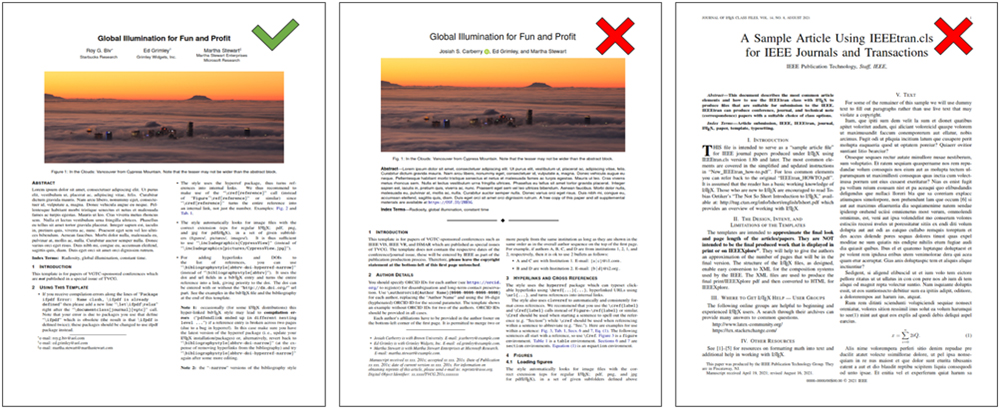
- All paper submissions must be formatted using the IEEE Computer Society VGTC conference format (https://tc.computer.org/vgtc/publications/conference/). See the visual examples below.
- MS Word template: At the time of writing this CFP, the provided .docx file may not comply with the VR formatting guidelines. Please use the provided .dotx file and ensure that the final submission matches the formatting guidelines or the paper may be DESK REJECTED. Check the provided sample pdf documents for correct formatting.
- Papers should be 4-9 pages of text, figures, and tables, but NOT including references. References should not exceed 2 pages in length. Note that the minimum length is 4 full pages of text. Appendices are included in the page count. Not following the page limits will be a DESK REJECTION.
- Supplementary materials should be provided in a separate file. Authors are encouraged to submit videos to aid the program committee in reviewing their submissions.
- Accepted papers will have to be formatted by the authors according to the relevant camera-ready guidelines.
Review responsibility
All senior authors (those holding a PhD or possessing equivalent expertise) should familiarize themselves with the IEEE VR 2027 [Review guidelines: TBA]. Unless serving IEEE VR 2027 in another capacity, ALL SENIOR AUTHORS are expected to volunteer as reviewers and perform their duties in a timely and responsive fashion. This supersedes the prior requirement that one author for each paper commit to reviewing; if a paper has multiple senior co-authors, all are expected to volunteer. Egregious violations of this policy may be considered highly irresponsible conduct (e.g., failure to meet deadlines or participate in discussions), which could result in penalties up to and including DESK REJECTION of their submitted paper(s).
Topics
IEEE VR 2027 seeks contributions in VR/AR/MR and 3DUI including, but not limited to, the following topics:
- 360° video
- 3D and volumetric display and projection technology
- 3D authoring
- 3D user interfaces
- Accessibility of immersive interfaces
- Audio interfaces and rendering
- Collaborative interactions
- Computer graphics techniques
- Crowd simulation
- Cybersickness
- Diversity and gender issues
- Embodied agents, virtual humans, and (self-)avatars
- Ethical issues
- Evaluation methods
- Haptic interfaces and rendering
- Human factors and ergonomics
- Immersive analytics and visualization
- Immersive applications and games
- Input devices
- Locomotion and navigation
- Mediated and diminished reality
- Mobile, desktop, or hybrid 3DUIs
- Modeling and simulation
- Multi-user and distributed systems
- Multimodal capturing and reconstruction
- Multimodal/cross-modal interaction and perception
- Multisensory interfaces and rendering
- Perception and cognition
- Presence, body ownership, and agency
- Redirection
- Software architectures, toolkits, and engineering
- Teleoperation and telepresence
- Therapy and rehabilitation
- Touch, tangible, and gesture interfaces
- Tracking and sensing
- User experience and usability
- XR technology infrastructure
While no list can be exhaustive, papers should, as a rule of thumb, engage meaningfully with existing literature in VR/AR/MR/3DUI. If a submission contains few or no references to this literature (focusing entirely on, for example, computer vision or computer graphics), that submission might not be appropriate for IEEE VR and may be DESK REJECTED.
Review Process
The review process will have two cycles.
Review Cycle I (Submission to Initial Notification)
Submissions will be assigned to two members of the VR 2027 International Program Committee (IPC): a coordinator (primary) and a secondary reviewer. Submissions that violate the submission guidelines or that receive low review scores from both the coordinator and the secondary reviewer will be rejected early. This stage of the review process will be double blind. We will strive to have all other submissions receive a total of at least three reviews. Based on the reviews and in consultation with a subset of the IPC, the Program Chairs will make one of the following initial recommendations for each submission:
- Conditionally accepted as IEEE TVCG paper: Continuing our cooperation with the IEEE Transactions on Visualization and Computer Graphics (TVCG), the top submissions wil* l be considered for publication in a special issue of IEEE TVCG.
- Conditionally accepted as conference paper: These submissions will be considered for inclusion in the Proceedings of IEEE VR, archived in the IEEE Xplore Digital Librar* y.
- Reject
Note: As of IEEE VR 2026, rejected papers will not have the option to be automatically accepted as IEEE VR Posters. Rather, authors of rejected papers will have to resubmit directly to the poster track.
Review Cycle II (Initial Notification to Final Decision)
Each conditionally accepted paper’s revision will be reviewed by its coordinator, who will make a final recommendation to the Program Chairs regarding acceptance. If the conditions for acceptance are not met, the paper will be rejected.
Additional Guidelines
Abstract Submission
Note that a paper abstract must be uploaded seven days prior to the actual paper submission deadline. This facilitates the process of assigning reviewers, as the review process operates on a very tight schedule.
Ethics and Responsibility
All submissions describing research experiments with human participants must follow the appropriate ethical guidelines required by the authors’ institution(s), and authors are required to secure and report their approval by the relevant ethics committee (IRB, below) prior to collecting data. An approval by any ethical review board, if required by your institution, needs to be indicated via the submission system and in the submission (with appropriate anonymization).
On PCS, authors will be required to choose one of the four options below, submit the name of the ethical review board, approved protocol title and number, and the date that ethical approval was obtained prior to running human participants. Of note, obtaining from an ethical review board an “exemption from full ethics approval” is “getting the study approved by the ethical review board”. In cases where ethics approval is not required by the institution, the authors have to clearly stipulate this in both their paper and on PCS. If the authors are not reporting on experiments involving human subjects, the authors will be able to indicate so. Authors must be able to provide proof of ethical approval upon request. Incorrect reporting of ethical approval will result in DESK REJECTION.
The options available in the PCS submission form:
- No human participants were involved in the research
- Approved by the ethical review board
- Authors’ institution or country does not require review by an ethical review board for the type of study conducted
- No ethical review board (IRB) approval was obtained
Participant Diversity
To support high-quality research, all submissions describing research with human participants should strive for participant diversity. As first steps toward this goal, VR 2027 is encouraging the following:
- Research that aims to benefit a general population should be representative of that population. (e.g., balanced across gender or age). Research that claims to benefit a specific population should clearly state and justify its focus on that population (e.g., pilots, surgeons).
- All submissions must report participant demographics (gender, age, etc.).
Notes about recruiting representative populations:
- Recruiting more diverse samples does not imply that the research must treat these data as independent variables and analyze differences in independent variables between demographic groups.
- Recruiting more diverse samples does not increase the number of participants required for adequate statistical power given an effect size.
- Many ethics review boards and funding sources already require participant diversity for inclusive and unbiased research.
The VR 2027 program committee and external reviewers will be strongly encouraged to consider participant diversity in relation to the generality of a submission’s claims as a first-order reviewing concern. Submissions that make general claims yet rely on a severely imbalanced participant group may be negatively impacted by the reviewing process.
Review Duties for Authors
The increasing number of submissions for IEEE VR makes us all dependent on a large number of good reviewers who are willing to provide constructive feedback and engage with authors on their work. Every paper needs three quality reviews.
To expand the reviewing pool and to promote quality reviews, for each submitted paper, all senior authors will be required to register to review as many papers as they are submitting (minimum of one) through PCS at the time of submission - although more would obviously be welcome. Additionally, senior authors are encouraged to ask experienced junior authors to register in PCS to review papers, and then to mentor the experienced junior authors during the review process.
Presentation at the Conference
All accepted submissions must be presented orally at the conference. An in-person presentation is expected, and online presentations will be accommodated only in exceptional cases. Requests for online presentations due to exceptional cases must be made at least one month before the conference.
Submission Language
All paper submissions must be in English. “American English” is not a requirement but we encourage authors to be consistent throughout the manuscript.
Previous Publication and Plagiarism
Submitted manuscripts must not have been previously published. A manuscript is considered to have been previously published if it has appeared in a peer-reviewed journal, magazine, book, or meeting proceedings that is reliably and permanently available afterward in print or electronic form to non-attendees, regardless of the language of that publication. A manuscript identical or substantially similar in content (in its entirety or in part) to one submitted to VR should not be simultaneously under consideration for another conference or journal during any part of the VR review process, from the submission deadline until notifications of decisions are emailed to authors.
Papers will be DESK REJECTED if they are discovered to have been published previously or to have been submitted concurrently at another conference or journal. We will follow IEEE policies on multiple submissions and plagiarism (https://www.comsoc.org/publications/journals/publication-policy-statements).
In some situations, a submission may build upon prior work. In order to fully explain the relationship between the submitted paper and prior work, authors may upload additional papers as well as a non-anonymous letter of explanation that highlights the significant changes or advances; these materials will only be seen by the primary reviewer. Specifically, this treatment is applied to the following cases:
- non-peer-reviewed works that are publicly available (as a technical report, white paper, etc.)
- non-archival publications presented in past IEEE VR conferences (posters, demos, etc.)
Submissions will be checked for plagiarism using IEEE Crosscheck. Detection of plagiarism will lead to rejection. For more information about definitions of plagiarism and IEEE policies in this area, please see the Introduction to the Guidelines for Handling Plagiarism Complaints and the IEEE Publication Services and Products Board Operations Manual.
Use of Generative AI
In accordance with IEEE guidelines, the use of content generated by artificial intelligence (AI) in an article (including but not limited to text, figures, images, and code) shall be disclosed in the acknowledgments section of any article submitted to an IEEE publication. The AI system used shall be identified, and specific sections of the article that use AI-generated content shall be identified and accompanied by a brief explanation regarding the level at which the AI system was used to generate the content.
Submission Anonymity
IEEE VR uses a DOUBLE-BLIND review process.
This means that both the authors and the reviewers must remain anonymous to each other. Submissions (including citations and optional videos) must not contain information that identifies the authors, their institutions, funding sources, or their places of work. Relevant previous work by the authors must be cited in the third person to preserve anonymity (exceptions were described above). Authors should work diligently to ensure that their submissions do not expose their identities either intentionally or through carelessness. Authors who have questions/issues around the double-blind submission policy should contact the program chairs.
Failure to adhere to the double-blind policy will result in DESK REJECTION.
Pre-dissemination through Public Online Repositories
Uploading the submitted manuscript to an online repository (e.g., arXiv) before the end of the review process does not constitute a reason for rejecting the manuscript. However, the authors should be advised that doing so can compromise the anonymity of their manuscript and therefore bias its double-blind review.
Videos
Videos must be submitted according to the instructions on the submission website. Videos submitted with papers will automatically be considered for possible inclusion in the video proceedings (video submissions may also be made independently, as described in the separate Call for Videos). When submitted as supporting material, videos must be free of any identifying information prior to reviewing as per the double-blind submission policy. If accepted for the video proceedings, a revised version of the materials will be requested.
Contacts
Papers Chairs:
- Lonni Besançon, Linköping University, Sweden
- Gerd Bruder, University of Central Florida, United States
- Shohei Mori, University of Stuttgart, Germany
- Misha Sra, University of California, Santa Barbara
- Xubo Yang, Shanghai Jiao Tong University, China
Contact email: TBD



© IEEE VR Conference 2027